Articles
BREEAM scoring and assessment: how it works

Posted by 
Learn how BREEAM scoring and assessment works and how our blocks can help you achieve the rating you’re aiming for.
As climate change makes itself felt, developers, architects and builders are changing the way they operate in order to promote more sustainable building practices. To help direct their action, and showcase their success, environmental assessment methods such as the Building Research Establishment Environmental Assessment Method (BREEAM) are growing in popularity.
But what does BREEAM consist of and how does BREEAM scoring work?
What is the BREEAM assessment process?
The BREEAM assessment process will vary a little depending on when you decide to start it.
It’s advantageous to involve a BREEAM assessor as early in the construction process as possible. However, BREEAM can be applied retrospectively or during the construction phase if necessary.
Here’s an outline of the BREEAM process from the very beginning.
Feasibility stage: At this stage of the BREEAM certification process, you engage a BREEAM assessor during your building’s design phase. This has the benefit of giving you feedback from a pre-assessment. You can then use this information to fine-tune your design to maximise your building’s rating potential.
Design stage: Once your design is finalised, the BREEAM assessor will formally analyse your building’s design against the BREEAM criteria. You will then be issued with a Design Stage Certificate.
Construction stage: When you begin construction, the BREEAM assessor will return and carry out another assessment. Once the building is complete, they will then check that you have actually implemented what you set out in your building design. This is known as the post-construction assessment.
Review stage: The assessments are then sent to the Building Research Establishment (BRE) to be reviewed. If they are satisfied, you will then receive your final BREEAM rating.
What are the BREEAM assessment criteria?
The following are all part of the BREEAM assessment criteria:
- Ecology: This examines the ecological value, conservation and enhancement of your proposed development site.
- Pollution: This considers your actions to limit air and water pollution.
- Waste: Waste is a huge issue in construction. You must therefore demonstrate how you will use your resources efficiently and minimise waste.
- Energy: This will look at how you manage your operational energy.
- Management: This refers to your management policy, commissioning, site management and procurement processes.
- Water consumption: How you manage your consumption and maximise efficiency.
- Health and wellbeing: You must demonstrate how you will protect future inhabitants from indoor and outdoor issues, such as noise and light pollution.
- Resources: This part of the assessment will weigh up the embodied impacts of your building materials over their whole lifecycle.
- Resilience: This section is a relatively new addition to the assessment, and it focuses on how you assess climate change risks and mitigate them.
- Transport: How you manage transport carbon emissions and other location-related factors.
Want more detail? Head over to our helpful article on BREEAM.
How long does BREEAM certification last?
A BREEAM certificate is valid for three years after it is first issued. By making the assessments cyclical, the issuing body (BRE) encourages designers, developers, builders and managers to keep monitoring, reporting and improving buildings’ environmental performance.
How does BREEAM scoring work?
In BREEAM assessments, you are scored according to a weighted system. This means that some assessment criteria are deemed to be more important than others.
For each of the BREEAM assessment categories, you will be awarded points that demonstrate how well you have fulfilled the BREEAM criteria. These points are then multiplied by the weighting factor of each section.
These scores are then added together to produce your BREEAM score.
Points are awarded by independent, licensed BREEAM assessors. Their assessments are then sent to the BRE for review.
What are the different BREEAM ratings?
In a BREEAM assessment, the more points you score overall, the better your BREEAM rating.
Below, we’ve outlined the thresholds in the BREEAM rating system:
- Outstanding: Scores that are greater or equal to 85%.
- Excellent: Scores that are greater or equal to 70%.
- Very good: Scores that are greater or equal to 55%.
- Good: Scores that are greater or equal to 45%.
- Pass: Scores that are greater or equal to 30%.
- Unclassified: Scores that are less than 30%.
What is a good BREEAM score?
In a literal sense, a ‘Good’ BREEAM score is one that has at least a 45% pass mark. For many developments, a ‘Good’ score is a solid achievement as it marks average attainment. For instance, it represents around 50% of commercial buildings submitted for assessment.
However, since 2012, there has been an increase in the number of ‘Very Good’ and ‘Excellent’ ratings for each part of the BREEAM assessment. This suggests that there may well come a time when higher scores are more the norm and a good score will be far higher.
At the moment, a building earning a ‘Good’ rating may not have sustainability as its top priority. For instance, budget constraints may be preventing the designers and developers from going all in and earning the highest scores.
A ‘Very Good’ rating, on the other hand, showcases buildings that have much more advanced good practices and a higher prioritisation of sustainability. But this is still lower than a building earning an ‘Excellent’ BREEAM score, which will demonstrate better practice in terms of the use of proven, modern technology and concepts. This is a much trickier ask, which is why only 10% of buildings achieve this level.
To achieve an ‘Outstanding’ score, buildings really must be innovative. This means that designers and builders must think outside the box more, employing careful planning and embracing the use of new technologies. For this reason, only around 1% of submissions currently achieve this rating.
How using Lignacite concrete blocks can contribute to BREEAM certification
If you’re aiming for a BREEAM assessment for your next project, our blocks can help you achieve your aims.
For the energy category, you can take advantage of the fact that our blocks can contribute towards reduced energy consumption thanks to their thermal mass. This is particularly the case with our Fair Face products. Their high thermal mass means that they can help to prevent a building from overheating, while also keeping it warmer in the cold months.
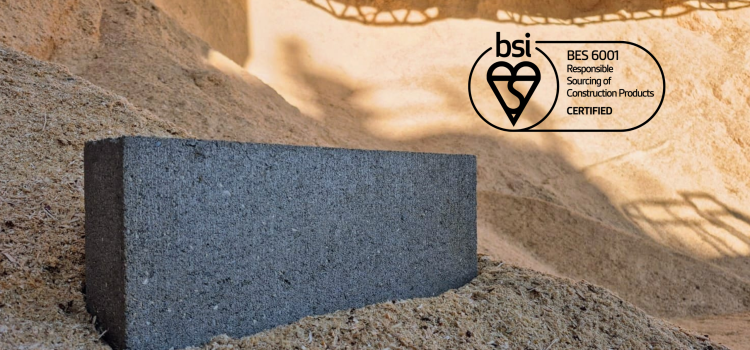
In terms of resources, you can earn points for using products that are responsibly sourced according to BES 6001. We also have Environmental Product Declarations (EPDs) for all of our products, which can help you evaluate your building’s overall performance.
Health and well-being is an important category in the BREEAM assessment. Our blocks boast exceptional sound insulation to help protect future inhabitants, earning you valuable points in your assessment.
Talk to us about your next project
If you’d like to find out more about our blocks and see if we’re the right fit for your next project, get in touch! You can call our friendly team on 01842 778485 or drop us an email at info@lignacite.co.uk.